Thermal processing is an important part of commercial food manufacturing, particularly for products that must remain safe and shelf-stable without refrigeration. Achieving consistent results requires equipment that can control heating, pressure, and cooling while distributing thermal energy effectively throughout the product load. Water spray technology is widely used in retort processing because it circulates heated water through a chamber to transfer heat to sealed food containers.
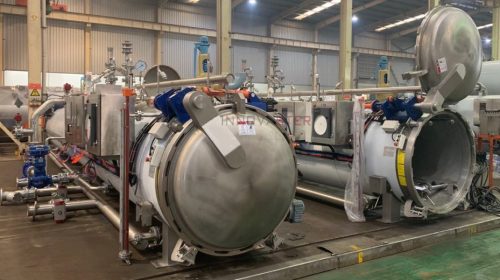
A Water Spray Autoclave is an industrial sterilization system that uses heated water distributed through spray nozzles to process packaged food products under controlled temperature and pressure conditions. Its performance depends on several connected factors, including water circulation, heat transfer, pressure regulation, loading arrangements, and process monitoring. Understanding these principles helps manufacturers select suitable equipment and maintain reliable production operations.
What Is a Water Spray Autoclave?
A water spray autoclave is a pressure-processing vessel designed to sterilize sealed food containers using circulating heated water. During operation, water is heated and pumped through a distribution network, where spray nozzles deliver it across the product load.
The heated water transfers thermal energy to the containers and their contents. After the required sterilization period, the system manages cooling under controlled conditions.
Water spray autoclaves are used for a range of packaged food products, including:
- Canned vegetables and fruits
- Meat and poultry products
- Seafood
- Soups and sauces
- Ready-to-eat meals
- Retort pouch products
- Other compatible heat-resistant packaged foods
The correct equipment configuration depends on the food formulation, packaging material, container dimensions, production volume, and validated thermal process.
Understanding Heat Transfer in Water Spray Autoclaves
Heat transfer is central to the operation of a water spray autoclave. The system must move thermal energy from the heating medium into the packaged product so that the required processing conditions are achieved.
1. Heating the Circulating Water
The process begins when the heating system raises the temperature of the water.
Depending on the equipment design, heating may be supplied through steam injection or a heat exchanger. The system must provide sufficient thermal energy to reach the required operating conditions for the intended product load.
2. Distributing Heat Through Spray Nozzles
A circulation pump moves heated water through pipes and spray nozzles inside the chamber.
The nozzles distribute water over the product baskets, helping expose containers to the heated medium. Their arrangement, flow characteristics, and condition influence the overall distribution pattern.
3. Transferring Heat Through Packaging
Once heated water contacts the container surface, thermal energy moves through the packaging material and into the food.
The rate of heat transfer depends on factors such as container material, wall thickness, product composition, and container dimensions.
4. Heat Penetration Within the Food
Heat penetration describes how thermal energy moves from the container surface into the food.
Different foods heat in different ways. Liquid products may transfer heat through natural or forced convection, while dense or solid products may rely more heavily on conduction.
The slowest-heating location inside the product is especially important when establishing a suitable sterilization schedule.
Why Uniform Heat Distribution Matters
Uniform heat distribution helps ensure that products in different chamber positions receive appropriate thermal exposure.
If heated water does not reach certain areas effectively, temperature differences may occur across the product load. These variations can affect processing consistency and require careful investigation.
Several factors influence heat distribution.
Spray Nozzle Positioning
Nozzles should be positioned to distribute water throughout the chamber.
Their location and spray characteristics must be compatible with chamber dimensions and product loading arrangements.
Pump Performance
The circulation pump must provide sufficient flow for the system’s design.
Reduced flow caused by mechanical wear, blockages, or unsuitable operating conditions can affect water distribution.
Product Basket Arrangement
Baskets and racks should be designed to support water movement around containers.
Overloading or using an unvalidated loading pattern may restrict circulation and create uneven thermal conditions.
Chamber Design
The chamber’s internal geometry and water distribution arrangement influence how effectively heated water reaches different locations.
Temperature distribution testing helps evaluate equipment performance under defined loading conditions.
Pressure Control During Thermal Processing
Pressure management is another important aspect of water spray autoclave operation.
As products heat, pressure inside sealed containers can increase. The retort must maintain suitable external pressure conditions to help protect packaging and support stable processing.
This is particularly important for flexible pouches, plastic containers, and other packaging formats that may be sensitive to pressure differences.
Maintaining Suitable Operating Pressure
The system monitors and regulates chamber pressure according to the established processing procedure.
Pressure requirements depend on the packaging type, product characteristics, and equipment design.
Protecting Packaging Integrity
During heating and cooling, differences between internal container pressure and chamber pressure can contribute to deformation or seal damage.
Appropriate pressure control helps reduce these risks.
Coordinating Pressure and Temperature
Temperature and pressure conditions are closely related during retort processing.
The control system should manage both parameters according to the validated thermal schedule rather than treating them as independent operating settings.
Main Components of a Water Spray Autoclave
A water spray system contains several components that work together to provide controlled thermal processing.
Retort Chamber
The chamber is the main pressure vessel where the product load is processed.
It must be designed for the required operating temperature and pressure and provide suitable space for baskets, racks, and water circulation.
Heating System
The heating system supplies thermal energy to the circulating water.
Its capacity should match the chamber size, product load, and expected cycle requirements.
Circulation Pump
The pump moves heated water through the distribution system.
Its performance affects water flow and spray coverage throughout the chamber.
Spray Nozzles
Nozzles distribute water over the product load.
They should be accessible for inspection and cleaning to maintain suitable spray performance.
Temperature and Pressure Sensors
Sensors monitor important operating conditions during heating, holding, and cooling.
Their accuracy is essential for reliable process control and documentation.
Control Panel
The control panel manages operating sequences and allows authorized operators to monitor the cycle.
Depending on the configuration, it may include programmable recipes, alarms, data recording, and process monitoring functions.
Cooling System
The cooling system reduces product temperature after the sterilization holding period.
Cooling must be managed carefully to protect containers and maintain suitable pressure conditions.
Operating Stages of a Water Spray Autoclave
Commercial water spray retort processing generally follows a sequence of controlled stages.
- Loading: Sealed containers are arranged in baskets or racks and placed inside the chamber.
- Chamber preparation: The door is closed and secured, and the system follows its required preparation procedure.
- Water heating: The heating system raises the circulating water to the required temperature.
- Water circulation: The pump distributes heated water through the spray nozzles.
- Sterilization holding: The system maintains the validated processing conditions for the specified period.
- Cooling: The product load is cooled under controlled temperature and pressure conditions.
- Unloading: Once the cycle is complete and the chamber is safe to open, products are removed for inspection.
The exact sequence and operating parameters depend on the retort design and the product-specific scheduled process.
Factors That Influence Process Uniformity
Uniform processing requires careful control of both equipment and product-related variables.
Product Formulation
Food composition influences thermal conductivity, viscosity, and heat penetration.
A thick sauce may heat differently from a liquid broth, even when both are processed in similar containers.
Container Dimensions
Larger containers may require more time for heat to reach the slowest-heating location.
Container shape and material also affect thermal behavior.
Fill Weight and Headspace
Variations in the amount of food inside a container can change heat transfer characteristics.
Consistent filling and sealing procedures help reduce batch-to-batch differences.
Initial Product Temperature
The temperature of the product before processing influences the amount of thermal energy needed to reach the required conditions.
Manufacturers should monitor initial product temperatures and follow the validated process requirements.
Loading Configuration
The position and spacing of containers influence water circulation around the product load.
The production loading arrangement should match the configuration used during process validation.
Automation and Process Monitoring
Automated controls can help operators manage repeatable processing cycles and monitor important operating conditions.
Programmable Recipes
Different products may require different processing schedules.
Programmable recipes allow authorized operators to select established parameters for specific product and packaging combinations.
Temperature and Pressure Monitoring
Sensors provide operating data throughout the processing cycle.
Alarm functions can alert operators when conditions move outside defined limits.
Batch Documentation
Depending on the control system, records may include:
- Batch identification
- Processing start and finish times
- Temperature readings
- Pressure readings
- Heating and cooling stages
- Alarm events
- Operator information
These records support traceability, quality assurance, and process review.
Process Validation and Food Safety
Reliable water spray autoclave operation requires more than reaching a target chamber temperature.
Manufacturers must establish that the equipment can distribute heat appropriately and that the product receives the required thermal treatment.
Two important evaluations support this work.
Temperature distribution testing examines how temperature varies throughout the retort chamber under defined operating and loading conditions.
Heat penetration testing determines how quickly heat reaches the slowest-heating location inside the food container.
These studies help qualified thermal processing specialists establish a scientifically supported processing schedule.
For low-acid shelf-stable foods, scheduled processes should be established in accordance with applicable regulations. Changes to formulation, packaging dimensions, fill weight, initial product temperature, or loading patterns may require a review or revalidation.
Maintenance Practices for Reliable Performance
Routine maintenance helps preserve water circulation, heating performance, and measurement accuracy.
Important activities include:
- Inspecting the chamber for corrosion or structural damage
- Checking door seals and pressure-related components
- Cleaning spray nozzles to prevent blockages
- Inspecting pumps, motors, and circulation piping
- Checking heating components and valves
- Calibrating temperature and pressure instruments
- Testing safety devices according to manufacturer procedures
- Reviewing process records for recurring alarms or variations
A preventive maintenance schedule should follow the equipment manufacturer’s recommendations and the facility’s operating conditions.
Common Problems That Can Affect Performance
Several issues may interfere with reliable water spray retort operation.
Blocked Spray Nozzles
Deposits or debris can restrict water flow and affect spray coverage.
Routine cleaning and inspection help maintain distribution performance.
Insufficient Water Circulation
Pump problems or flow restrictions can reduce circulation and create temperature variations.
Monitoring pump condition and system flow helps identify potential problems.
Inaccurate Temperature Readings
Uncalibrated sensors can provide misleading information about chamber conditions.
Regular calibration is necessary for reliable monitoring.
Incorrect Loading Patterns
Overloading or unsuitable product arrangements can restrict water movement around containers.
Manufacturers should follow validated loading procedures.
Poor Cooling Control
Inadequate cooling management can affect product quality and packaging integrity.
Cooling conditions should follow the established process and equipment requirements.
Choosing a Water Spray Autoclave for Commercial Production
Selecting suitable equipment requires an assessment of production requirements and product characteristics.
Manufacturers should evaluate:
- Required batch capacity
- Product types and formulations
- Container dimensions and packaging materials
- Heating and cooling performance
- Water circulation capacity
- Pressure control features
- Automation and monitoring functions
- Available steam, water, and electrical utilities
- Maintenance access and service support
- Applicable equipment safety requirements
The selected system should support the intended production schedule without compromising validated processing conditions.
Conclusion
Water spray autoclaves support commercial food sterilization by combining heated water circulation, controlled pressure, and managed cooling. Their performance depends on effective heat transfer, uniform spray distribution, suitable loading arrangements, and accurate process monitoring.
Manufacturers should evaluate equipment design alongside product formulation, packaging compatibility, and production capacity. With proper maintenance, qualified process validation, and consistent operating procedures, water spray retorts can help food processors achieve dependable thermal processing while protecting product quality and packaging integrity.