An industrial filter must do more than capture particles. It must maintain the required flow rate, withstand process conditions, fit the equipment, and deliver predictable performance over its service life. A poorly selected element can create excessive pressure drop, clog too quickly, or deteriorate when exposed to the process fluid. Sintered metal filters offer a durable porous structure for many industrial applications, but choosing the right one requires a systematic review of operating requirements.
When comparing Sintered Metal Filters, buyers should start with the contaminant and process fluid, then evaluate filtration rating, permeability, material, pressure, temperature, and cleaning method. A filter that performs well in one system may be unsuitable for another, even if the nominal pore specification appears similar.
Define what must be removed
The first step is to identify the contaminant. Its particle-size distribution, shape, concentration, hardness, and tendency to form deposits can all influence filter selection. Some processes involve relatively uniform particles, while others contain a broad mixture of solids or fibers.
The required filtration outcome should be clear. A system designed to protect a pump from larger debris may need a different filter from one intended to remove fine particles before a sensitive downstream operation. Engineers should distinguish between nominal and absolute filtration ratings and confirm the test method used to establish the supplier’s stated performance.
It is also important to consider whether the contaminant is likely to accumulate quickly. High solids loading may require a larger filtration area, a cleaning arrangement, or a staged filtration system rather than a single fine element.
Match the material to the process fluid
The filter material must remain compatible with the liquid or gas it contacts. Stainless steel is a common choice for applications where corrosion resistance and durability are priorities, but not all stainless grades behave identically in every chemical environment.
Process temperature, concentration, pH, cleaning chemicals, and exposure time should be considered. If the fluid contains aggressive substances, material compatibility should be checked against documented technical data. The housing, seals, and fittings must also be compatible; selecting a suitable filter element does not protect an assembly whose other parts degrade.
Where product purity is important, buyers may also need information about cleanliness, surface condition, and any substances that could be released from the filter during operation.
Balance filtration rating and flow
Filtration efficiency and flow resistance must be evaluated together. A finer porous structure may retain smaller particles but can also increase pressure drop. If the filter is too restrictive, the pump may not deliver the required flow, or energy consumption may rise.
Permeability, available surface area, media thickness, and system pressure all affect performance. A larger filter element may provide more filtration area and reduce the rate at which contaminants load the media. In some systems, multiple elements can be arranged to provide greater capacity or easier maintenance.
Engineers should request pressure-drop information at relevant flow rates rather than relying on a single maximum-flow figure. Operating conditions should resemble the actual process as closely as possible.
Select the right shape and connection
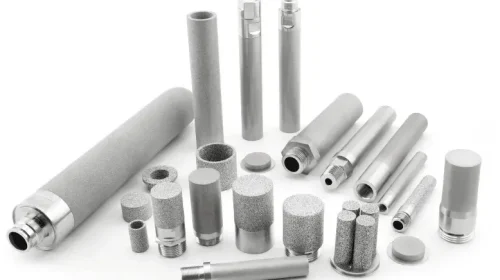
Sintered metal filters can be made as discs, tubes, plates, and other configurations. The shape should suit the available housing and required flow path. Tubular elements may offer substantial surface area, while disc formats can fit compact filtration assemblies.
Dimensions, connection type, sealing method, support structure, and installation orientation should be specified. The design must prevent fluid from bypassing the filter media. It should also provide adequate support against pressure differences and mechanical loads.
Consider cleaning and maintenance from the start
A reusable metal filter can be attractive where cleaning restores performance without damaging the media. However, not every contaminant can be removed easily. Sticky deposits, embedded particles, or chemical residues may require specialized cleaning procedures.
Ask the supplier which cleaning methods are approved and how the element should be inspected afterward. Maintenance planning should include monitoring pressure drop, flow changes, visible damage, and corrosion. A filter should not remain in service simply because it can still pass some fluid; it must continue to meet the required filtration performance.
Verify supplier capability
A reliable manufacturer should provide material details, dimensions, filtration specifications, permeability or flow data, pressure limits, temperature limits, and relevant test information. Samples can be evaluated in a representative system before full-scale purchasing.
For critical processes, acceptance criteria should be documented. These may cover dimensions, filtration performance, pressure integrity, cleanliness, and traceability. Any change in powder, production method, or material grade should be managed through an agreed approval process.
Make filtration performance measurable
Choosing a sintered metal filter is a balance between particle retention, flow capacity, mechanical durability, and maintenance. Defining the process conditions and verifying the element under realistic operating parameters helps prevent avoidable performance problems. A well-matched filter supports stable operation, protects downstream equipment, and makes maintenance planning more predictable.