Moving temperature-sensitive goods through a supply chain requires more than careful driving and prompt delivery. Products may pass through warehouses, loading areas, distribution vehicles, and several handling points before reaching their destination. At every stage, environmental conditions can change. For businesses transporting food, healthcare supplies, laboratory materials, or other sensitive goods, suitable packaging is an important part of protecting product quality and maintaining reliable operations.
A purpose-designed Cold Chain Transport Box helps create an insulated environment around goods during handling and transportation. Depending on its construction and intended application, it may combine thermal insulation, a durable outer shell, a secure lid, and practical handling features. Choosing the right design involves assessing the product’s temperature requirements, expected journey conditions, and the procedures used by the shipping team.
1. Thermal Insulation for Temperature Stability
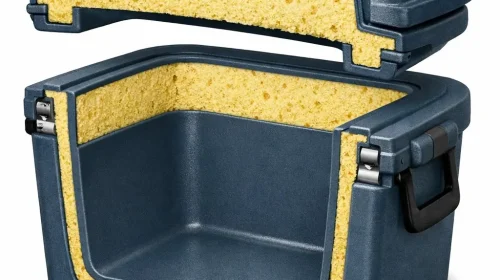
The main purpose of an insulated transport box is to slow heat transfer between the contents and the outside environment. Its walls create a barrier that can reduce the speed at which the internal temperature changes.
The performance of this barrier depends on insulation material, thickness, construction quality, lid fit, and the conditions surrounding the shipment. A container may perform differently during a short indoor transfer than during several hours in a hot delivery vehicle.
Businesses should review available performance data and test packaging under realistic conditions. Insulation is not an active refrigeration system, so suitable cooling materials or other temperature-control equipment may also be necessary.
2. Secure Lid and Reliable Closure
A well-fitting lid is essential to the overall function of a cold chain container. Gaps around the closure can allow unwanted heat exchange, while an insecure lid may open during handling or transportation.
When comparing designs, inspect the lid alignment, closure mechanism, hinges, and any sealing features. The lid should be easy for staff to operate while remaining secure during movement.
Repeated use is another consideration. A closure that works well during initial inspection should also be suitable for regular opening and closing throughout the container’s service life.
3. Durable Construction for Repeated Handling
Transport equipment is frequently lifted, stacked, loaded, unloaded, and moved between work areas. A durable outer structure can help protect the contents from ordinary handling stresses.
Look at the quality of the walls, corners, handles, and base. If containers will be stacked, confirm that their design supports the intended arrangement and that the load remains stable. Overloading or stacking unsuitable containers can create avoidable damage.
The internal surfaces should also be compatible with the cleaning and maintenance procedures required by the business.
4. Practical Capacity and Internal Arrangement
A cold chain transport box should accommodate the shipment without forcing staff to pack products too tightly. Excessive pressure can damage packaging, while large unused spaces may make it harder to arrange cooling materials efficiently.
Businesses should measure their common products and determine how much room is needed for protective packaging, dividers, and temperature-control elements. A range of container sizes may be more useful than relying on one oversized model.
Where multiple products share a shipment, clear separation and labeling can help prevent mix-ups and simplify receiving procedures.
5. Compatibility With Temperature-Control Materials
Different products may require different cooling approaches. Depending on the specified temperature range, businesses might use conditioned gel packs, phase-change materials, or other approved cooling components.
Their quantity and placement should be determined through appropriate packing instructions or testing. Direct contact between cooling elements and products may be unsuitable for some goods, particularly where freezing could cause damage.
The container should provide enough usable space to position the cooling materials without compromising the product arrangement. For sensitive shipments, temperature monitoring can provide evidence of the conditions experienced during transit.
6. Ease of Cleaning and Maintenance
Reusable transport containers need regular inspection and cleaning. Smooth, accessible internal surfaces can make routine maintenance easier, while damaged areas or difficult-to-reach corners may create hygiene challenges.
Staff should follow the manufacturer’s cleaning guidance and any relevant industry procedures. Containers should be dried before storage where required, and defective lids, handles, or insulation should be assessed before the equipment is used again.
A simple maintenance record can help businesses identify recurring problems and plan replacements before equipment failure disrupts deliveries.
7. Features to Match to the Shipment
Before choosing a model, assess the following practical requirements:
- Temperature needs: Identify the acceptable range for the product.
- Transit duration: Include loading time, delivery time, and possible delays.
- Insulation performance: Compare available test information and operating conditions.
- Container capacity: Allow room for the products and temperature-control materials.
- Handling requirements: Consider weight, grips, stacking, and vehicle compatibility.
- Monitoring: Decide whether a data logger or temperature indicator is required.
For regulated goods, confirm whether formal packaging qualification, validation, or other compliance documentation is needed.
Conclusion
A reliable cold chain transport box combines suitable insulation with secure construction, practical capacity, and easy maintenance. These features help businesses organize temperature-sensitive deliveries and reduce exposure to changing conditions during transit. When the container is matched to the shipment and used with appropriate cooling methods, monitoring, and handling procedures, it can become a dependable part of a well-managed cold chain.