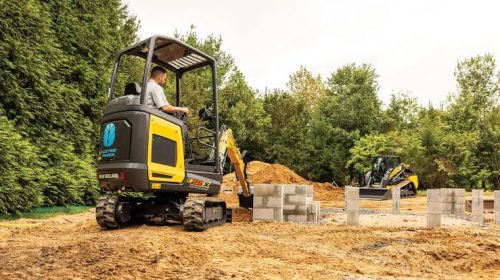
Small workspaces can create significant challenges for construction and excavation professionals. Restricted access, nearby structures, limited turning room, narrow pathways, and the presence of existing landscaping may prevent larger machinery from reaching the intended working area. Contractors operating in these environments need equipment that can fit the available space while still providing the capabilities required for the job.
An electric mini excavator combines a compact machine configuration with an electric power system, making it worth considering for selected projects involving limited working space. Its design may help contractors address access restrictions and undertake localized excavation, although suitability depends on the machine’s dimensions, performance specifications, and the site’s operating conditions.
Compact Construction and Space Efficiency
Mini excavators are designed for excavation tasks where smaller equipment may be more appropriate than full-sized machines. Their compact dimensions can help contractors work in areas with restricted access or limited space for positioning.
Machine width, height, length, operating weight, and tail swing characteristics influence how the excavator moves around a site. These measurements should be compared with actual access conditions before purchase.
Small workspaces may include narrow residential passages, courtyards, commercial service areas, landscaped properties, and restricted renovation locations. Compact equipment can offer greater flexibility in these environments when it has sufficient room to operate safely.
Maneuverability and Positioning
Equipment maneuverability affects how easily a machine can move between working positions. In confined areas, contractors may need to reposition frequently as excavation progresses or as different tasks are completed.
A mini excavator’s track configuration, turning characteristics, and working geometry can influence its ability to operate within a restricted area. The machine should be evaluated for both travel and working clearance.
Boom and arm movement also matter. Operators need sufficient space to dig, reposition the bucket, place material, and move attachments without contacting nearby structures or other obstacles.
Design Considerations for Existing Properties
Small-workspace construction often takes place around existing buildings, pathways, fences, driveways, garden features, and other completed elements. The equipment must be selected and operated with these surroundings in mind.
Compact machines may help reduce the area required for equipment movement, but contractors still need to assess ground conditions, surface protection, and operating weight. Finished paving, lawns, or sensitive surfaces may require protective measures.
The machine should have a clearly defined travel route and operating zone. Site preparation can help prevent unnecessary repositioning and reduce the risk of damage to surrounding property.
Electric Power and Working Environments
Electric operation may provide additional advantages in selected small-workspace environments. Because electric excavators produce no direct exhaust emissions during operation, they may be suitable for certain indoor or semi-enclosed applications where exhaust management is a concern.
Electric machinery may also reduce engine-related noise, which can be relevant when working near occupied properties or in noise-sensitive locations. However, excavation, hydraulics, tracks, and attachments still generate sound.
Contractors must evaluate ventilation, charging arrangements, electrical safety, and other site-specific requirements before using machinery indoors or in restricted environments.
Access and Transport Requirements
Compact design does not automatically guarantee easy transport. Buyers should review the machine’s transport dimensions, operating weight, loading arrangements, and compatibility with their available trailer or transport vehicle.
Small sites may have restricted delivery areas or limited space for unloading. Contractors should plan equipment arrival, loading and unloading, movement into the work zone, and eventual removal.
Where access includes ramps, uneven surfaces, narrow turns, or low overhead clearance, these conditions should be assessed before mobilization.
Practical Excavation Applications
Compact excavators may support localized digging, trench preparation, landscaping, drainage improvements, small foundation work, and property maintenance.
The machine’s digging depth, reach, bucket capacity, and operating weight should be appropriate for the planned task. Contractors should also identify any attachments needed and verify compatibility before purchase.
The excavator may help reduce manual effort on suitable activities, but its capabilities should not be overstated. Work involving difficult ground, large excavations, heavy lifting, or restricted stability conditions may require different equipment or additional planning.
Charging and Daily Operation
Electric equipment requires charging arrangements that match its expected workload. Buyers should examine battery capacity, operating duration, charging time, and electrical supply requirements.
Small projects may involve short periods of operation separated by breaks, while other jobs may require extended digging. Charging should be integrated into the schedule according to realistic energy consumption and manufacturer recommendations.
Conclusion
Electric mini excavator design can provide advantages for selected small-workspace projects by offering compact dimensions and an alternative power system. Its usefulness depends on access, working clearance, excavation capability, ground conditions, transport, charging, and safety. Contractors who assess these factors carefully can determine whether compact electric machinery is suitable for their restricted-space applications and project demands.