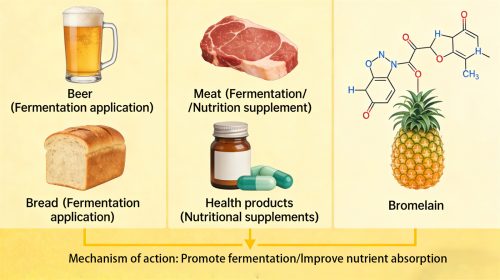
Enzyme ingredients require a different approach to quality management from many conventional food ingredients. Their functional properties depend on biological activity, and environmental exposure or unsuitable processing conditions may affect their performance. For businesses working with bromelain, understanding how the enzyme preparation is handled, stored, tested, and incorporated into a production process is essential for maintaining predictable results.
Manufacturers evaluating Bromelain Enzyme Powder should consider its activity specification, processing compatibility, moisture exposure, storage conditions, packaging, and batch verification. These factors contribute to the ingredient’s practical suitability and help establish appropriate controls from warehouse receipt through manufacturing use.
Processing Conditions and Enzyme Activity
Bromelain is a proteolytic enzyme preparation that can catalyze protein breakdown under suitable conditions. Its activity may be influenced by temperature, pH, reaction time, substrate characteristics, concentration, and the specific preparation being used.
Manufacturers should consult technical documentation to understand the product’s recommended operating conditions. Activity values are typically established using defined analytical methods, and results should be interpreted according to the supplier’s specification.
During production, temperature management is particularly relevant. Enzymes may lose activity when exposed to unsuitable conditions, including excessive heat. However, the degree of sensitivity depends on the enzyme preparation and exposure conditions.
Processing teams should establish operating parameters through controlled testing rather than relying on general assumptions about enzyme behavior.
Dosage and Reaction Management
The quantity of bromelain required depends on the intended application and the characteristics of the raw material being processed. Dosage should be determined using the enzyme’s activity specification and verified through trials.
In protein-processing applications, the degree of hydrolysis may influence texture, functional properties, and other characteristics. Excessive enzymatic treatment can produce undesirable results, making reaction time and dosage important control variables.
A structured trial should document the ingredient amount, substrate characteristics, temperature, pH, mixing, reaction duration, and relevant analytical or sensory results.
These records help manufacturers identify conditions that provide the desired outcome and support repeatability during commercial production.
Storage Requirements
Enzyme powder storage should follow the supplier’s instructions. Environmental factors such as moisture, temperature, prolonged exposure, and packaging condition may influence activity retention.
Containers should remain properly sealed when not in use. Warehouses should be maintained according to the material’s documented requirements, and employees should avoid exposing opened packages to unsuitable conditions during dispensing.
Storage records can help demonstrate that the ingredient has been managed appropriately. Inventory rotation should also be implemented to ensure that material is used within its established shelf-life period.
Packaging and Handling
Packaging protects the enzyme during transportation, storage, and routine handling. Buyers should review container suitability, closure integrity, labeling, and the packaging configuration offered by the supplier.
At the manufacturing site, procedures should address opening, weighing, dispensing, transferring, and resealing the material. Clean utensils and appropriate handling practices help prevent contamination and ingredient mix-ups.
Employees should also follow relevant workplace safety instructions, including the supplier’s safety documentation and the facility’s handling procedures.
Quality Specifications and Testing
A quality specification should clearly identify the enzyme preparation and establish relevant acceptance criteria. Activity is an important parameter, but other characteristics may also be required, depending on the intended use.
Testing may include identity, activity, moisture, microbiological quality, physical characteristics, and additional criteria established by the manufacturer. Certificates of analysis should be checked against the approved specification and associated with the supplied batch.
Periodic verification testing may provide additional confidence in incoming material quality. If results differ from expected values, the material should be evaluated through the company’s established nonconformance procedures.
Monitoring Stability
Manufacturers should understand the ingredient’s documented shelf life and any conditions that may affect stability. Storage practices should be reviewed when warehouse environments change or when materials are held for extended periods.
Where appropriate, stability-related verification can help assess whether material remains suitable within the manufacturer’s established requirements.
Integrating Quality Into Daily Operations
Bromelain powder management requires coordination between purchasing, quality assurance, warehouse staff, and production teams. Documented specifications, controlled storage, suitable processing conditions, and traceable handling support more consistent operations.
By treating enzyme quality as a continuous management responsibility rather than a receiving-stage inspection alone, manufacturers can make better use of bromelain and reduce avoidable variability in their processing activities.