

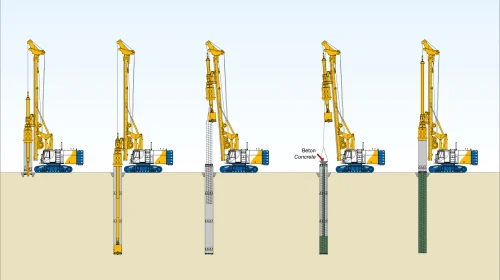
In modern foundation engineering, deep piling systems are essential for constructing safe and durable infrastructure. As construction projects expand in scale and complexity, engineers rely on specialized drilling equipment to handle different soil conditions and load requirements efficiently. These machines ensure that foundations reach stable ground layers capable of supporting heavy structural loads.
A pile drilling rig is designed to perform precise deep-hole drilling for pile installation in various ground conditions, and a pile drilling rig is widely used in civil engineering because of its adaptability, efficiency, and ability to create strong foundations in both urban and industrial environments where soil stability is often unpredictable.
Table of Contents
ToggleOverview of Pile Drilling Rigs in Foundation Engineering
Pile drilling rigs are heavy-duty machines used to create deep boreholes where reinforced piles are installed. These rigs play a critical role in transferring structural loads from buildings and infrastructure into deeper, more stable soil or rock layers.
Unlike traditional pile driving methods that rely on impact force, drilling rigs focus on controlled excavation. This approach improves precision, reduces vibration, and minimizes disturbance to surrounding structures. As a result, they are commonly used in sensitive construction zones and large-scale infrastructure projects.
Rotary Pile Drilling Rigs
Rotary drilling rigs are among the most widely used types in modern construction. They operate by rotating a drill bit to cut through soil and rock layers, gradually creating a borehole.
These rigs are highly efficient and suitable for a wide range of soil conditions, including clay, sand, and mixed formations. Their versatility makes them a preferred choice for high-rise buildings and bridge foundations.
Key advantages include:
- High drilling accuracy
- Ability to handle deep foundations
- Suitable for diverse soil types
- Efficient material removal system
CFA (Continuous Flight Auger) Drilling Rigs
CFA drilling rigs use a continuous auger to drill into the ground while simultaneously filling the borehole with concrete as the auger is withdrawn. This method eliminates the need for casing in many cases.
These rigs are especially useful in soft or unstable soil conditions where borehole collapse is a concern. They are commonly used in urban construction due to their low noise and vibration levels.
Typical applications include residential buildings, retaining walls, and infrastructure projects in dense city environments.
Impact Rotary Combination Rigs
Some construction sites require rigs that combine both rotary and impact drilling techniques. These hybrid machines are designed to handle extremely hard soil or rock formations where standard rotary methods may not be sufficient.
By combining drilling and impact force, these rigs improve penetration efficiency in challenging geological conditions.
They are often used in large-scale infrastructure projects such as dams, tunnels, and heavy industrial foundations.
Long Auger Drilling Rigs
Long auger rigs are designed for relatively shallow but large-diameter piling work. They use extended auger tools to quickly remove soil and create space for concrete piles.
These rigs are commonly used in road construction, bridge abutments, and foundation reinforcement projects where speed and efficiency are prioritized over extreme depth.
Their advantages include fast operation and cost-effective performance in suitable soil conditions.
Hydraulic Pile Drilling Rigs
Hydraulic drilling rigs are powered by advanced hydraulic systems that provide strong torque and precise control. These rigs are widely used in modern construction due to their stability and efficiency.
They are suitable for deep foundation projects where consistent drilling power is required, especially in mixed or dense soil layers.
Hydraulic systems also allow smoother operation, reducing mechanical stress and improving equipment lifespan.
Industrial Applications of Pile Drilling Rigs
Pile drilling rigs are used across a wide range of industrial and infrastructure projects. Their ability to create stable deep foundations makes them essential in modern construction.
Common applications include:
- High-rise commercial and residential buildings
- Bridges and elevated highways
- Rail infrastructure and metro systems
- Airports and terminal foundations
- Power plants and heavy industrial facilities
- Marine and coastal structures
Each of these applications requires precise load distribution and long-term structural stability, which drilling rigs are designed to provide.
Factors Influencing Rig Selection
Choosing the right pile drilling rig depends on several engineering and environmental factors. Soil type, project scale, depth requirements, and site accessibility all play a role in selection.
For example, urban projects often prioritize low-vibration rigs, while industrial sites may require high-power machines capable of drilling through rock layers.
Proper selection ensures efficiency, safety, and cost-effectiveness throughout the construction process.
Technological Advancements in Modern Drilling Rigs
Modern pile drilling rigs are increasingly equipped with advanced features such as automated controls, real-time monitoring systems, and improved hydraulic efficiency. These innovations enhance precision and reduce human error during operation.
Digital monitoring systems also help engineers track drilling depth, torque levels, and soil resistance, improving overall project management and quality control.
Conclusion
Pile drilling rigs are essential tools in modern foundation engineering, offering a wide range of solutions for different soil conditions and construction requirements. From rotary and CFA systems to hydraulic and hybrid rigs, each type serves a specific purpose in industrial and infrastructure development. Understanding their differences and applications helps engineers choose the right equipment, ensuring stable, efficient, and long-lasting foundation structures.

